vendredi 27 novembre 2009


Smilodon (pronounced /ˈsmаɪlədɒn/), often called saber-toothed cat or saber-toothed tiger, is an extinct genus of the subfamily machairodontine saber-toothed cats endemic to North America and South America living from the Early Pleistocene through Lujanian stage of the Pleistocene epoch (1.8 mya—10,000 years ago), existing for approximately 1.790 million years

A number of Smilodon species have been described, but today usually only three are recognized.[2]

Smilodon neogaeus/populator skeleton
Smilodon gracilis, 2.5 million-500,000 years ago; the smallest and earliest species (estimated to have been only 55 to 170 kg (120 to 370 lb))[3] was the successor of Megantereon in North America, from which it probably evolved. The other Smilodon species probably derived from this species.
Smilodon fatalis, 1.6 million-10,000 years ago, replaced Smilodon gracilis in North America and western South America. In size it was between Smilodon gracilis and Smilodon populator, and about the same as the largest surviving cat, the Siberian Tiger. This species is estimated to have ranged from 250 to 360 kg (550 to 790 lb).[3] Sometimes two additional species are recognized, Smilodon californicus and Smilodon floridus, but usually they are considered to be subspecies of Smilodon fatalis.
Smilodon populator, 1 million-10,000 years ago; occurred in the eastern parts of South America and was the largest species of all machairodonts. It was 1.2 m (47 in) tall, 2.1 m (83 in) long on average and had a 30 cm (12 in) tail. With an estimated weight of 400 kg (880 lb), it was among the heaviest known felids.[3] Its upper canines reached 28 cm (11 in) and protruded up to 17 cm (6.7 in) out of the upper jaw.

The young of big cats are called cubs rather than kittens. Either term may be used for the young of smaller wild felids such as ocelots, caracals, and lynx, but "kitten" is usually more common for these species. Though the term primarily refers to young cats, it can also be used when talking about the young of beavers, hedgehogs, rabbits, rats, sA litter of kittens usually consists of two to five kittens. They are born after a gestation that lasts between 64–67 days, with an average length of 66 days.[2] Kittens emerge in a sac called the amnion which is bitten off and eaten by the mother cat.[3]
For the first several weeks, kittens are unable to urinate or defecate without being stimulated by their mother. They are also unable to regulate their body temperature for the first three weeks, so kittens born in temperatures less than 27
°C (80 °F) can die from exposure if they are not kept warm by their mother.
The mother's milk is very important for the kittens' nutrition and proper growth. This milk transfers
antibodies to the kittens, which helps protect them against infectious disease.[4] Newborn kittens are also unable to produce concentrated urine, and so have a very high requirement for fluids.[5]
Kittens open their
eyes about seven to ten days following birth. At first, the retina is poorly-developed and vision is poor. Kittens are not able to see as well as adult cats until about ten weeks after birth.[6]kunks and squirrels

jeudi 26 novembre 2009


Cats are obligate carnivores and hence, must eat animal tissue to maintain their long-term well-being. If left on its own the cat survives on whatever small animal prey is available in the habitat. From the muscle of its prey, the cat obtains protein. And from the bones and viscera (intestines and other organs), it obtains vitamins, minerals, and other important nutrients. The cat also meets most of its fluid requirements through its prey. The cat's tendency to eat small but frequent meals.Food provides the cat with nutrients - proteins, carbohydrates, fats, minerals, vitamins, and water - that are crucial to the growth, reproductive, and adult stages of its life cycle. Cats require two essential amino acids - taurine and arginine. Taurine deficiency in cats causes reproductive problems, blindness, and heart disease. An arginine-deficient diet leads to a situation in which the cat develops toxicosis because it can't adequately convert the harmful waste product ammonia into urea (normally eliminated via the urinary system). To avoid the dangers of taurine and arginine deficiencies in cats: make sure that the cat's diet contains adequate amounts of these and other essential amino acids.A cat's protein requirement varies according to its life stage. A healthy adult cat's diet should contain 30 to 45 percent protein on a dry-matter basis (without the water content of the food). To fulfill protein's requirement buy meat-based high protein cat food. As such cats do not require carbohydrates but most of the cat foods contain carbohydrates. A healthy adult cat's diet should contain 10 to 30 per cent fat on a dry-matter basis. Cats also need vitamins and minerals. But we want to strike a note of caution here - Do not add vitamin or mineral supplements to cat's food without first consulting a veterinarian. It would do more harm than good.Several factors influence cat's gastronomic habits. Smell and taste play a major role in shaping cat's food preferences. In terms of flavor, cats prefer salty, sour, or bitter-tasting substances. Cats don't develop a sweet tooth because they have no perception of simple sugars. Cats prefer food that is close to their own body temperature.Contrary to the cat's image cats must develop a taste for milk. Many cats do not enjoy cow milk. Cow's milk can occasionally be a problem for cats that do enjoy it. Some adult cats cannot effectively digest cow's milk (lactose intolerance), which can result in diarrhea.

mardi 24 novembre 2009


Les tigres sont les plus grands félins vivant sur notre planète. Mais aussi beaux et puissants soient-ils, leur avenir est cependant loin d’être assuré.
Au début du 20ème siècle, près de 100.000 tigres vivaient encore dans la nature. Aujourd’hui, on estime à environ 6.000 seulement le nombre de survivants. Pas de quoi être fier, donc ! De plus, sur les huit sous-espèces (ou "races") présentes au siècle passé, seules cinq survivent encore aujourd’hui. Certaines personnes se sont vêtues de manteaux en peau de tigre (véritable ou synthétique) simplement pour attirer l’attention. C'est surprenant quand on songe que la parure rayée du tigre lui sert, au contraire, à passer inaperçu. En effet, lorsqu’il se glisse silencieusement dans les hautes herbes ou entre les arbres, l’alternance de rayures claires et foncées lui permet de "casser" sa silhouette et de ne pas se faire remarquer. Ces rayures sont aussi la carte d’identité du tigre, car il n’existe pas deux individus ayant exactement le même dessin. Les spécialistes qui étudient les tigres se basent d’ailleurs sur la forme des rayures de la tête pour identifier avec plus de facilité les différents individus.


Le lion blanc est une forme mutante du lion de la sous-espèce Panthera leo krugeri ; il ne s'agit pas d'une sous-espèce séparée. On le croise occasionnellement dans les réserves naturelles d'Afrique du Sud, et il fait l'objet d'élevages sélectifs dans des zoos du monde entier. Selon les croyances africaines, cet animal est divin et croiser sa route porte bonheur. Son existence a été révélée au public dans les années 1970 par Chris McBride dans son livre Les lions blancs de Timbavati (The White Lions of Timbavati).
Le gène responsable de la mutation est récessif, si bien que les lions blancs restent rares dans la nature et seul un couple de lions blancs peut avoir des lionceaux blancs à coup sur ; il arrive que des lionceaux blancs naissent de lions normaux à Timbawati et dans le parc national de Kruger. La plus grande population de lions blancs se trouve dans les zoos, où ils sont élevés dans le but de perpétuer leur couleur, ce qui présente des risques de consanguinité.
Les lions blancs, pour la plupart, ne sont pas atteints d'albinisme. Leur mutation est appelée leucistisme (ou parfois chinchilla), et donne à leur fourrure une couleur qui varie du blond au blanc presque pur. Cette couleur donne aux animaux un désavantage certain dans la nature car elle les rend très visibles aux yeux de leurs proies et en fait une cible facile pour les prédateurs.


Répartition :Le Jaguar est originaire d'Amérique du Sud, on le trouve au Guatemala, Venezuela, Brésil, nord de l'Argentine, au nord du Mexique et à Honduras. Il est présent également au sud des Etats-Unis, dans les états du Nouveau-Mexique et d'Arizona.Le Jaguar peut vivre en bord de mer, mais également en altitude, on le trouve jusqu'à 2 700 mètres dans les Andes. Mais, il préfère vivre proche des bords d'eau où le gibier abonde. Sa population est estimée à 50 000 individus avec une tendance au déclin.
Le Jaguar est classé par IUCN comme une espèce "quasi menacée" d'autant plus que son habitat naturel, la forêt amazonienne est peu à peu détruite. L'autre danger provient de la chasse pour sa fourrure. Bien qu'ayant beaucoup diminué depuis les années 70, le braconnage existe toujours. De plus avec les avancées de la civilisation et de l'agriculteur qui empiète sur le territoire naturel des Jaguars, les Jaguars, proche du bétail, rentrent souvent en conflit avec les éleveurs.

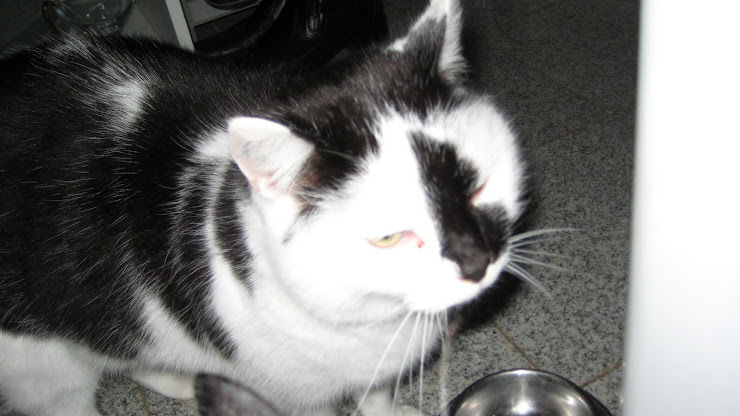
The cat (Felis catus), also known as the domestic cat or housecat[5] to distinguish it from other felines and felids, is a small carnivorous mammal that is valued by humans for its companionship and its ability to hunt vermin and household pests. It has been associated with humans for at least 9,500 years[6] and is currently the most popular pet in the world.[7]
A skilled predator, the cat is known to hunt over 1,000 species for food. It can be trained to obey simple commands. Individual cats have also been known to learn on their own to manipulate simple mechanisms, such as doorknobs and toilet handles.[8] Cats use a variety of vocalizations and types of body language for communication, including meowing, purring, trilling, hissing, growling, squeaking, chirping, clicking, and grunting.[9] They are also bred and shown as registered pedigree pets. This hobby is known as cat fancy.
Until recently the cat was commonly believed to have been domesticated in ancient Egypt, where it was a cult animal.[10] A study in 2007 found that the lines of descent of all house cats probably run through as few as five self-domesticating African Wildcats (Felis silvestris lybica) circa 8000 BC, in the Near East.[4] The earliest direct evidence of cat domestication is a kitten that was buried with its owner 9,500 years ago in Cyprus.